

Dear Friends,
I trust you had a grand 4th of July celebration!
I’ve always enjoyed George M. Cohan’s “You’re a grand old flag, You’re a high-flying flag, and forever in peace may you wave!” And so we continue to pray for peace at home and abroad.
This podcast, in large part, is thanks to the recent writings of David F. Watson, President of Asbury Theological Seminary. Please, go to his Substack site for more of his observant and inspirational thoughts.
Thanks for joining me on The Church’s One Foundation, and a very warm welcome to two of our new subscribers.
As always…
Pressing On!
D. Paul
Goodbye To The Ties That Bind
I was saddened but not surprised to read that the United Methodist Church had severed its long-standing relationship with Asbury Theological Seminary. Informally, that relationship dates back to the seminary’s inception in 1923 and was formalized in 1946 when The Methodist Church (a predecessor to the United Methodist Church) “approved” of its aspiring seminarians being educated at Asbury Theological Seminary. It was again formally “approved’ by the United Methodist Church in 1981. Currently, approximately 9% of ATS’s student body “identify” as UMC. When those presently enrolled or matriculating in the fall of ‘26 graduate, that number may well dwindle to near zero.
A statement from the UMC General Board of Higher Education and Ministry said that the June ‘26 meeting of the denomination’s University Senate included the removal of both Asbury Theological Seminary and Northeastern Seminary in Rochester, New York, from its “list of approved non-United Methodist schools.” Asbury Theological Seminary, based in Wilmore Kentucky, acknowledged the UMC’s decision and responded, “This outcome reflects a determination made by the UMC rather than a shared resolution.” ATS’s new President, David F. Watson (happy one-year anniversary, Dr. Watson, and your baptism by fire!), said in a statement, “The Senate’s requirements, particularly those related to the UMC’s 2024 Social Principles concerning ‘Human Sexuality’ and ‘Marriage,’ are not aligned with Asbury Theological Seminary’s institutional ethos and the historic witness of the Christian faith.” Amen and amen.
In 2024 UMC’s social principles were radically revised at its quadrennial 2024 General Conference. Delegates voted to excise a 1972 statement in the rule book calling homosexuality “incompatible with Christian teaching.” Then, under “revised principles” in the section on marriage, they inserted a statement that altered the denomination’s course irreversibly: “Within the church, we affirm marriage as a sacred, lifelong covenant that brings two people of faith, an adult man and woman of consenting age, or two adult persons of consenting age into union with one another.” By stark contrast, Asbury Seminary’s position has been and remains unwavering, reflected by President Watson’s response to the UMC’s recent “delisting” (June ‘26) of ATS as an “approved” seminary: “We affirm marriage as sanctioned by God, which joins one man and one woman in a single, exclusive union for life, as delineated in Scripture, and provides the sole context for sexual intimacy, helping to ensure the blessings of that relationship as God intended.”
In a little less than 300 years from when John Wesley landed on the shores of Savannah, Georgia, to convert the Indian (only to find that he himself was not converted), the United Methodist Church has gone the way of all flesh, folding to the demands of the LGBTQIA activists within its ranks. If there were tears in heaven, Wesley would be weeping. Encouragingly, though, many of the faithful among UMC’s laity, clergy, and bishops (and there are thousands) are unhappy with its church affirming the sexual and gender madness of our age. Nor are they happy with this recent split with Asbury Theological Seminary. Bishop David Graves of the UMC Kentucky-Tennessee Episcopal Area speaks for the “disappointed” when he says: “For many clergy and laity across Kentucky and Tennessee, Asbury is more than an institution. It is a place where faith was deepened, callings were clarified, friendships were formed, and lives were changed.”
Imagine with me, if you will, an experience that will surely occur after the historic affiliation between the UMC and ATS expires after the 2026 Fall enrollment: You are a young man or woman who has had an encounter with the living Christ. You’ve experienced the “new birth,” and, not unlike the Wesley of old, you can say, “I felt my heart strangely warmed” when you opened your heart’s door to the gentle knocking of Jesus. Soon, you feel God’s call on your life to full-time ministry. You attend, fortunately enough, a Bible-believing United Methodist church in Tennessee. You check out the 13 United Methodist schools of theology and find them wanting. You hear of a Bible-believing seminary just a couple hundred miles up the road from you in Wilmore, Kentucky, and find Asbury Theological Seminary. You check out their website, and see at the top of its title page:

—its 103-year-old founding vision statement—followed at the bottom of the page with, presumably, its mission statement:
“...a community called to prepare theologically educated, sanctified, Spirit-filled men and women to evangelize and to spread scriptural holiness throughout the world through the love of Jesus Christ, in the power of the Holy Spirit and to the glory of God the Father.”
You smile broadly, you feel the tug of the Holy Spirit, your heart, once again, strangely warmed, and you know you’ve found the right school to prepare you for ministry. You’ve yet to hear of the disaffiliation between the UMC and ATS and go to your local pastor confident of the Spirit’s direction, only to be told that the bishop won’t approve of your attending Asbury Theological Seminary. The bishop can’t prevent your attending the seminary, but neither he/she nor the United Methodist Church will approve it, with obvious, deleterious implications for any subsequent ordination and appointment you might desire within the denomination. Disappointed but not deterred, you return home and fill out the online application for Asbury Theological Seminary, assured it is God’s will for your life, and it is His will you desire more than the stamp of approval from your bishop. Fortunately, UMC’s dissociation in no way affects ATS’s institutional accreditation and the seminary will remain an “approved theological institution” for the 75+ denominations it serves, including the rapidly growing Global Methodist Church. You are at peace and enroll at Asbury Theological Seminary.
One could argue that years ago ATS should have “come out from among them [the UMC] and be separate” (2 Cor 6:17 NIV), but cutting “the ties that bind” was a decision the UMC had to make, for it was they who left the legacy of Wesley with its scriptural holiness. ATS would have continued to welcome UMC students eager for an orthodox, evangelical education. On the seminary’s website, (https://asburyseminary.edu/news/asbury-theological-seminary-addresses-recent-united-methodist-church-decision/), President Watson pays homage to those precious bonds that united Asbury Theological Seminary to the United Methodist Church: “We value our long history of serving United Methodist students and churches, and we are grateful for decades of partnership. Today, more than 4,000 living Asbury Theological Seminary alumni affiliated with The United Methodist Church are serving, or have served, faithfully around the globe. We love and respect our United Methodist students, alumni and faculty, whose presence has enriched our community for generations. We pray for God’s continued blessing on them as they minister faithfully across denominational lines.”
Despite this gracious blessing on “the ties that bind,” President Watson is no rosy-eyed, milquetoast compromiser to the hard facts on the ground. He will “…fight hard for the faith which has been once and for all entrusted to God’s holy people.” On his Substack site, he writes: “We will teach the whole Bible for the whole world. We will love God with all our minds, engaging our faith with the highest level of scholarly work, and laying it all at the feet of Jesus. And if that means that we are loved by some and despised by others, so be it. If that means that long and fruitful partnerships must come to an end, we accept that. We will not sell our birthright for a mess of pottage. The Gospel of Jesus Christ, handed on from the time of the apostles, is too precious, too powerful, too glorious for us to make it a matter of negotiation.”
These are words of courage, of commitment, words of praise and hope.
And though their “separation narratives” vary from Asbury Theological Seminary, the Global Methodist Church, the Anglican Church of North America, the Presbyterian Church in America, the Lutheran Church-Missouri Synod, etc., and numerous non-denominational churches have painfully, yet with grace and dignity, experienced first-hand how “…long and fruitful partnerships must come to an end….” Spawned by its acceptance of same-sex marriage and its endless ripples of multiple genders, an apostate church will continue to provoke this great schism within the Church at large. Correct me, my friends, I pray, but until Christ comes to claim His Bride, it strikes me as an irreparable schism. In many cases, it will no longer be “Blest be the ties that bind,” but “Goodbye to the ties that bind.”
Inevitably, as recorded in the Book of Jude, God’s judgment, not ours, will come to an ungodly, apostate church, for “They are wild waves of the sea, foaming up their own shame, wandering stars, for whom blackest darkness has been reserved forever (Jude 1:13 NIV). And so, we pray for the United Methodist Church. And let us, my brothers and sisters in Christ, knowing that the gates of hell will not prevail upon His Church, be of “courage, commitment, praise and hope,” joining President Watson, the faculty, and the faithful seminarians of Asbury Theological Seminary in “contending,” yes “fighting hard,” by His power, “for the faith that was once for all entrusted to God’s holy people (Jude 1:3 NIV).
Amen
PS: Pray, dear friends, for Asbury Theological Seminary. For more on President Watson’s thorough analysis on “Where is Asbury Seminary Going?,” read the inspiring link below:

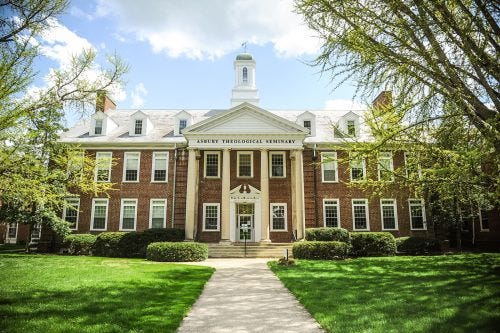
The Henry Clay Morrison Administration building at Asbury Theological Seminary in Wilmore, Kentucky. (Photo courtesy of Asbury Theological Seminary/Wikimedia/Creative Commons)


