

Dear Friends,
Welcome to the “Church’s One Foundation!” Apologies for running a day late, and without so much of a heads-up being sent your way! Shame!
But the last few days have been spent in preparation as a “candidate for reception” into All Souls Anglican Church here in Indianapolis and the Anglican Church of North America. Debby and I have been attending All Souls for over a year now, and it was time to affirm and formalize our affiliation.
Regardless of what church you may be attending, I trust you’ll enjoy this brief overview of TO BE A CHRISTIAN—An Anglican Catechism. You can go to this link to review all the rich material contained therein: https://anglicanchurch.net/wp-content/uploads/2020/06/To-Be-a-Christian.pdf
I hope, my brothers and sisters, you’re experiencing a blessed Pentecost! He did not leave us comfortless! And so…
Pressing On!
D. Paul
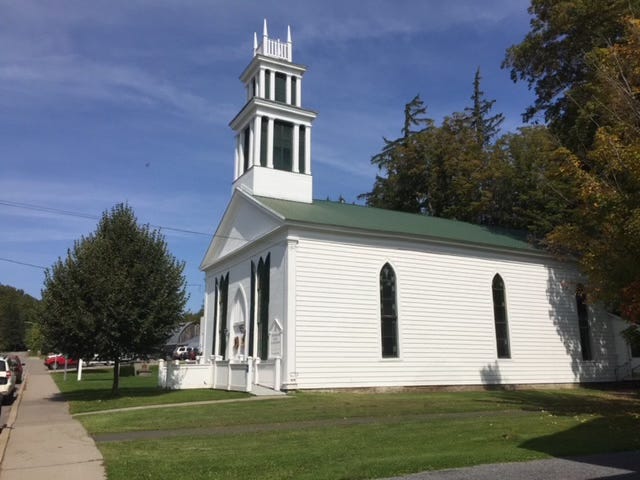
TO BE A CHRISTIAN
This Sunday, May 31st, Deborah Ann and I will be “received” in a Confirmation service into All Souls Anglican Church and the Anglican Diocese of the Great Lakes, and as members of the Anglican Church of North America. Having already been confirmed in the Episcopal Church fifty-six and thirty-six years ago respectively, Debby and I checked “Reception: Already confirmed in the Roman Catholic, Orthodox or Episcopal Church” when asked “Which rite are you applying for?” on the “All Souls Confirmation, Reception, Reaffirmation Application.” Our priest, Father David Trujillo, assures us that we’re “ready to go,” along with a dozen other joyful confirmands and candidates for reception.
Speaking for myself, it feels like I’ve come full circle. The Church of the Nazarene, in which I was brought up, is a direct descendent of the Church of England (the original church of the Anglican Communion)—only two denominational steps removed, if you will. Although John Wesley never abandoned his ecclesiastical affiliation—“I was born an Anglican, I have lived an Anglican, I shall die an Anglican”—the Methodists broke away from the increasingly liberal Anglican Church even as the Nazarenes broke away from an increasingly liberal Methodist Church some hundred years later. Such cycles of devolving orthodoxy and church schisms appear inevitable, but may it not be so, I pray, for the Anglican Church of North America, which has broken away from an increasingly liberal Episcopal Church. Certainly, the An Anglican Catechism they’ve authored—TO BE A CHRISTIAN, “contends for the faith which was once delivered unto the saints” in a thorough, succinct, and biblically-based manner.
In preparation for our “reception,” I’ve been reading through sections of its 160 pages, the final 21 pages being an INDEX OF SCRIPTURE. The catechism’s purpose is made clear in Part I—BEGINNING WITH CHRIST: “This catechism is designed to teach you what it means to be a Christian. It shows you what is essential for Christian faith and life. It will open for you the door to knowing Jesus Christ and experiencing the wonder of God’s love through him. If you follow its teaching, it will help you to become a citizen of God’s kingdom and fully involved in the life and mission of his Church. And it will anchor you in the reality of God’s unquenchable joy, beginning in this life and ever increasing in the life to come…. However, one can understand these things and still remain apart from them. In order to know God’s love for you, you need to know and love Jesus Christ, and commit yourself to him as his lifelong disciple in his community, the Church.”
From beginning to end, the catechism is all about Jesus. It reminds me of Phineas F. Bresee’s preaching, the founder of the Church of the Nazarene: “Nothing to the right, nothing to the left—Jesus only!”
Later, under the subheading, TURNING TO CHRIST, it reads: “When the disciple Thomas encountered the risen Jesus, he acknowledged him by saying, ‘My Lord and my God!’ (John 20:28). To be a Christian you must, like Thomas, wholeheartedly submit to the living Christ as your Lord and God. Knowing the Lord Jesus means personally believing in him, surrendering your life to him through repentance and Baptism, and living as one of his joyful followers.” Nothing half-hearted here. We’re challenged to be “all in.” Then, under point 9 of SALVATION, it answers its own rhetorical question: Is there any other way of salvation? No. The apostle Peter said of Jesus, “There is salvation in no one else” (Acts 4:12). Jesus is the only one who can save me and reconcile me to God. (Psalm 2; Isaiah 42:1–4; John 14:5–6; 1 Timothy 2:5–6)
In PART II, BELIEVING IN CHRIST, we’re introduced to THE APOSTLES’ CREED AND THE LIFE OF FAITH, accompanied by the effective question and answer template employed throughout: What is a creed? A creed is a statement of faith. The word “creed” comes from the Latin credo, which means “I believe.” (Deuteronomy 11:18–23; 26:1–11; John 20:24–29; 1 John 5:9–12) What is the purpose of the creeds? The purpose of the creeds is to declare and safeguard for all generations essential truths about God, the Church, and the world, as revealed in Holy Scripture.” (Deuteronomy 7:9–11; Psalm 145:4–13; John 20:30–31; 2 Timothy 1:13–14; Hebrews 2:1–4)
Many at All Souls Anglican Church know the Apostles’ Creed by heart (including my wife), and it is spoken full-voiced, no fingers crossed behind the back, without a second of hesitation:
“I believe in God, the Father almighty, creator of heaven and earth. I believe in Jesus Christ, his only Son, our Lord. He was conceived by the Holy Spirit and born of the Virgin Mary. He suffered under Pontius Pilate, was crucified, died, and was buried. He descended to the dead. On the third day he rose again.
He ascended into heaven, and is seated at the right hand of the Father He will come again to judge the living and the dead. I believe in the Holy Spirit, the holy catholic Church, the communion of saints, the forgiveness of sins, the resurrection of the body, and the life everlasting.” Amen.
With so many of our evangelical churches, particularly the megachurches, becoming little more than a videoed, spiritualized Ted Talk packaged in a couple of praise hymns,* millions of Christians (particularly new ones) leave church on a Sunday morning having no idea what they really believe, other than feeling good and “happy” about themselves. On the flip side, the “progressive” churches have fallen prey to the “high altar of social justice” and their own self-righteous version of what this “social justice” must look like, diminishing the Lordship of Jesus to nothing more than a passing footnote in the “gospel of love, love, love” where “anything goes.”
After clearly establishing the authority of God’s word—“CONCERNING HOLY SCRIPTURE”— as “given by the Holy Spirit through prophets and apostles as the revelation of God and his acts in human history, and is therefore the Church’s final authority in all matters of faith and practice” (Psalm 19:7–11; Jeremiah 36:1–8; 2 Timothy 3:14–17; Revelation 1:1–11), TO BE A CHRISTIAN—An Anglican Catechism, continues with PART III, BELONGING TO CHRIST, with a great delineation of The Lord’s Prayer, followed by Part IV, BECOMING LIKE CHRIST, which highlights JUSTIFICATION AND SANCTIFICATION, taking me right back to my holiness roots: Thus, the Christian life of holiness is rooted in the gracious union that believers have with the Father, through the Son, and by the Holy Spirit.
How does Jesus heal you? Through the gift of the Holy Spirit, as I continue in repentance and faith, Jesus mends my disordered soul from the effects of sin in my mind, will, and desires. (2 Chronicles 7:12–14; Psalms 25:4–11; 41:4; 103:1–5; 2 Corinthians 3:17–18)
What is this healing called? This healing is called “sanctification,” which means to be made whole and holy. By the work of the Holy Spirit, my mind, will, and desires are increasingly transformed and conformed to the character of Jesus Christ. (Proverbs 2; John 17:15–17; Romans 12:1–2; 1 Corinthians 6:9–11; Ephesians 2:1–10; 3:14–21)
I close, my brothers and sisters in Christ, with this prayer, which can be used In preparation for Confirmation:
Grant, Almighty God, that we, who have been redeemed from the old life of sin by our baptism into the death and resurrection of your Son Jesus Christ, may be filled with your Holy Spirit, and live in righteousness and true holiness; through Jesus Christ our Lord, who lives and reigns with you and the Holy Spirit, one God, now and forever.
Amen
*Nothing against “praise” songs, by the way. I love the good ones. And, no doubt, many megachurches are bringing people to a saving knowledge of our Lord Jesus Christ. Thanks be to God! And thank God for the “small groups,” which are often the conduit in enabling fresh believers “…to comprehend with all saints what is the breadth, and length, and depth, and height; And to know the love of Christ, which passeth knowledge, that [they] ye might be filled with all the fulness of God” (Ephesians 3:18-19 KJV).
AN AFTERWORD: The catechism’s statement below on marriage sets the Anglican Church of North America apart from the Episcopal Church and other denominations that affirm same-sex marriage. What is Christian marriage? Christian marriage, or Holy Matrimony, is a lifelong covenant between one man and one woman, uniting them in self-giving love, joy, and faithfulness. It is ordained by God for the procreation and spiritual nurture of children, the sanctification of husband and wife, the mutual support of their common life, and the flourishing of family, church, and society. Husband and wife enter into this covenant by exchanging vows before God and in the presence of witnesses. (Genesis 2:18–25; Song of Solomon 4:7–10; Matthew 19:3–9; John 2:1–11; Romans 7:2–3; Hebrews 13:4; see questions 322–23)
Amen and Amen
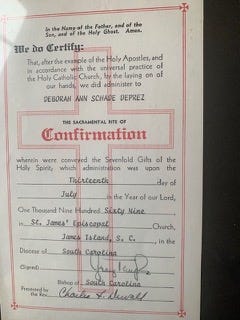
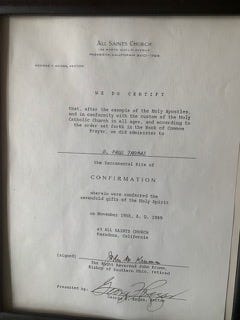
Our “ancient” Confirmations
THE CHURCH’S ONE FOUNDATION IS JESUS CHRIST HER LORD!


