


Dear Friends,
I trust you’re enjoying these early days of summer. We’ve a beautiful one here today in Indianapolis.
I’ve written today’s podcast over the last few days. In some ways, it may read like a “flow of consciousness,” but I’ve enjoyed pondering on “betrayal” and “friendship,” and I hope you enjoy it also.
I’m grateful for you, and let’s keep praying for one another. The good Lord knows, I need them, and perhaps you do too. As always…
Pressing On!
D. Paul

BETRAYAL
Is there anything more precious and fragile than friendship? To have and keep a friend through all the seasons of one’s life is rare; it is priceless.
Live long enough, though, and the ending of certain friendships are inevitable. Unless you are blessed beyond compare, more than likely you will be the recipient or the catalyst of betrayal—a common denominator in the dissolution of relationships: a friend has “had it” with you; a spouse leaves for greener pastures; an angry son exits not to be heard from for years; a beloved pastor commits an indiscretion; a trusted business partner confiscates funds. As loyalty and fidelity become scarce commodities in our disposable culture, betrayal is all about us. We abandon one another with little thought other than for ourselves.
When asked on “Good Morning America” to sum up the next chapter of her life in one word, I was not surprised to hear Michelle Obama respond with a succinct “me.” It is the baseline of our age. It’s all about me, me, me—my boundaries, my space, my privacy, my priorities. No wonder the Jesus who calls us to deny ourselves, take up our cross and follow Him, is so radically counter to the spirit of our age. Barack Obama was more lighthearted, responding to the question with the one word, “fun.” Both responses, nonetheless, were disappointing. One might have hoped to hear such words as “service,” “charity,” “philanthropy,” “reconciliation,” “faith,” “prayer,” even “God,” for what could be more excellent than to dwell on the Almighty in the next chapter of one’s life. Granting them both some grace, though, anyone who sat under the ministry of the Reverend Jeremiah Wright for years and absorbed his toxic theology and worldview (made famous by his “G** D*** America” sermon), is bound to fall short on occasion. And just to keep things in political balance: I’m not a respecter of either party here. No one is better at making it “about himself” than President Trump.
In truth, the “it’s all about me” syndrome is easier for me to relate to than I’d like to admit. As an actor, narcissism seems to be the natural byproduct of our profession, at least that’s how we justify it. The big ego, the prima donna-ish temperament that takes up a lot of space and oxygen is necessary for the work, or so we fool ourselves in thinking. By contrast, humility, being an empty vessel, and having the courage to step on the stage transparently and inhabit the life of another person is the sign of the true artist, not the prima donna absorbed with his or her own life. As the great acting teacher, Uta Hagen, used to say (and I paraphrase slightly), “Leave yourself with its worries at the stage door.” Once you step “onto the boards,” the well-drawn character will provide you all the angst you need. And the chances are that “betrayal” will be at the heart of it all. For where would art be —the theatre, film, TV, all of literature—without betrayal. Certainly the Bard of Avon drew upon it continuously: Brutus’s betrayal of Julius Caesar—“et tu, Brute,” and you, Brutus?—Caesar’s dying words; Iago betraying Othello by lying to him about Desdemona’s supposed unfaithfulness; “King Lear,” with its betrayal by Goneril and Regan, feigning undying love for their faltering father; Prince Hal in Henry IV/Part II, who upon becoming King Henry the Fifth, banishes his exuberant, youthful comrade, Sir John Falstaff, from court, who eventually dies, we discover, from a broken heart; “Hamlet,” with its betrayal upon betrayal leading to murder upon murder. Betrayal is the artistic motif and “stuff” of life that keeps on giving—a distinctive talent, it would seem, of a fallen humanity.
And certainly, betrayal was nothing new to our Savior, Jesus Christ: “He came unto his own and his own received him not” (John 1:11 KJV). Herod massacred dozens in search of the infant Jesus. Judas Iscariot, of course, is our prime example, betraying the Lord with a kiss in the Garden of Gethsemane in return for a mere pittance—a handful of silver coins—thus becoming ever since the quintessential personification in art and literature of betrayal. And despite Peter’s pledge of loyalty at the Last Supper—“Even if all fall away, I will not”—he soon found himself in the courtyard of the High Priest, Caiaphas, where he would betray Jesus “thrice,” even as Christ had said he would. The other disciples fled in fear, and, but for a faithful few, Jesus was abandoned on the cross. Such betrayal continues today with the self-adoring Church—a feckless Bride—abandoning his Lordship and the veracity of his Word for a feel-good gospel of self-actualization, with its self-aggrandizing menu of assorted sexual/gender identities. Take your pick—your identity is not “in Christ”—it’s your choice, not God’s. And like the foolish virgins whose wicks had not been trimmed and whose lamps were void of oil, the faithless Church of today is void of the power of the Holy Spirit, obsessed with itself rather than its glorious Bridegroom. By the time the apostate Church wakes up, if it ever does, shouting “Lord, Lord…open the door for us,” the door to the heavenly wedding party may well be closed, and the unfaithful will hear those ominous words of Christ: Truly I tell you, I don’t know you. (Matthew 25:11,12 NIV).
I want to be known, don’t you?
Miraculously, our merciful Savior is not desirous that any should perish and continues to hold out his hand of fellowship for all who would want to come in and dine with Him. Never doubt, dear reader, that God—the Creator of all—traversed through time and space to have a personal, intimate relationship with his creation—with you. I’m reminded of an old Gospel hymn, Friendship With Jesus, the text originally entitled A friend of Jesus, O What Bliss, written in 1898 by Joseph C. Ludgate and put to music by the ever-endearing Stephen Foster. The refrain goes:
Friendship with Jesus, fellowship divine,
O what blessèd, sweet communion,
Jesus is a friend of mine!
Betrayal upon betrayal could not deter the unquenchable love of Jesus. And so to his disciples and to us, my dear brothers and sisters in Christ, he says: “I have called you friends, for everything that I learned from my Father I have made known to you (John 15:15 NIV). What a fathomless thought—“Jesus is a friend of mine!”—the great, transcendent “I Am Who I Am” become flesh, “For God was pleased to have all his fullness dwell in him (Col 1:19,NIV), and that He would deign to dwell among us, choosing the way of the cross for our sins, the very sins of those who rejected and betrayed Him, and in so choosing “…demonstrate his own love for us in that while we were yet sinners, Christ died for us" (Rom 5:8)—a selfless, self-sacrificial death, revealing for all time the boundless and endless love of God! Hallelujah!
My dear friends, may we, the Church—his Bride—keep our lamps burning bright!
Amen
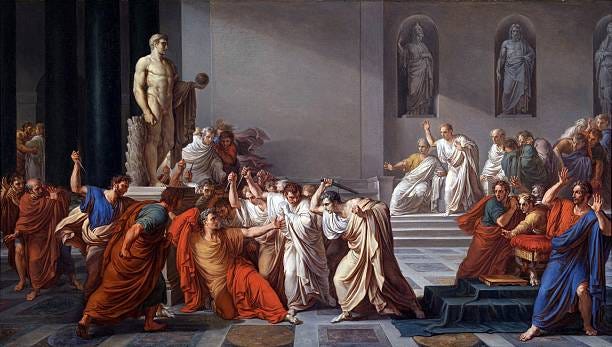
The Death of Julius Caesar by Vincenzo Camuccini, Public Domain “Ingratitude, more strong than traitor’s arms, quite vanquished him” (Julius Caesar).
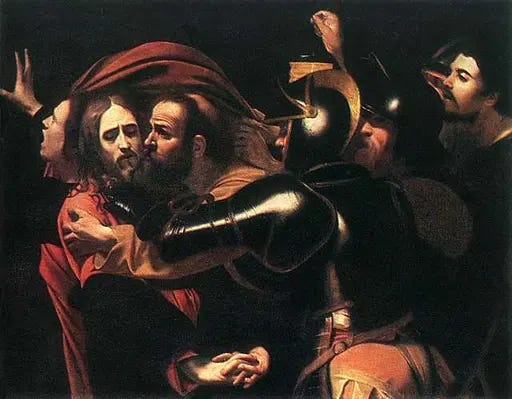
Photo of “The Taking of Christ” by Caravaggio - Odessa - Public Domain Judas betrays Jesus with a kiss.


